
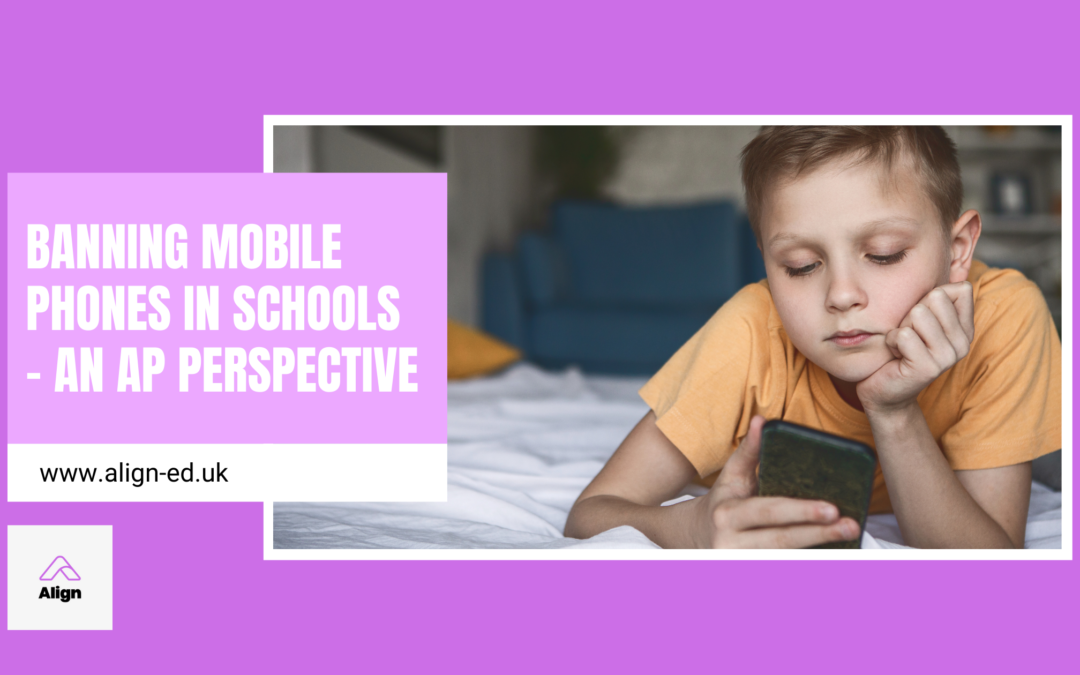
Banning mobile phones in schools - an AP perspective
There is evidence which suggests that some children are distracted by mobile phones in class and that this impacts on academic outcomes. There are also studies which indicate that abusive use of phones accounts for a significant percentage of behavioural problems which manifest in school time. Unlike its English counterpart, the Welsh government (Senedd), has judged that there is not enough evidence to justify a complete ban at present.
On 19th January 2026 the Department for Education issued updated guidelines for the use of mobile phones in schools. At the same time guidance for Ofsted around inspecting school mobile phone policies has been tightened, with expectations that teachers do not use phones for personal reasons around students.
The new guidelines (non-statutory for now) require that schools are ‘phone-free environments by default’ and that ‘anything other should be the exception’; this includes during lunch and break times.
The DfE guidance acknowledges that it will be important to make reasonable adjustments for children who have particular additional needs; it’s clear, however, that Ofsted inspectors will be scrutinising the ways in which schools manage phone use and this will impact special schools and non-school AP which schools refer to.
The Independent School Standards were last updated in 2019; under Section 2 ‘Spiritual, moral and cultural development of pupils’ independent schools are required to ensure that children have ‘a fully developed value system, and be able to interact with other people in a positive way’; under Section 3 ‘Welfare, health and safety of pupils’ Safeguarding and Behaviour policies must be in place and it’s recommended that:
…proprietors ensure that their (safeguarding) policy and practice is based on a wide view of what may happen to pupils, not only in schools but also beyond it. Although schools are not responsible for the welfare of pupils when they are not in school or on school visits, schools can still play a significant role in ensuring that the vulnerability of pupils in other parts of their lives is reduced. For example, an effective anti-bullying strategy will ensure that pupils are taught about the dangers of cyber-bullying and sexting.
In the latest updated guidance for inspectors the DfE requires inspectors to identify disadvantaged students including those with SEND to ‘ensure that leaders are identifying and addressing pupils’ needs effectively’. The guidance also directs inspectors to establish whether the school is using external AP and to visit APs being used by the school to ensure that standards are being met.
When I ran an AP and Independent Special School our behaviour policy underpinned all school functions. Our approach was based on relationships of trust in which staff took responsibility for ‘being the adult’ with all the complexities and challenges this entails. One of our rules was that children and adults did not look at phones during lesson time.
Our students had social, emotional and mental health barriers to full inclusion, and often struggled to regulate their emotions; nevertheless, they were able to respect this expectation on all but very rare occasions. We did not insist on phones being handed in or put in lockers; we understood that for our students it was important to feel safe, and that the connection their phones represented could be an important element of this.
We allowed children to use their phones outside of teaching time for exactly this reason. One student who suffered from developmental trauma was extremely attached to her grandmother, the only fully trusted adult in her life. Without the reassurance that her grandmother could contact her whenever needed, this child was unable to function at school. We could not have worked effectively with this child had we banned her from having her phone with her at all times, or forbade her to take calls from her gran if an emergency arose (it never did).
It’s true to say that despite success in managing phone use well, there were instances where phones caused disruption to school life. Social media was a trigger for relationship difficulties between children in the school and peers outside. Many fallings out were caused or exacerbated by social media content posted outside of school time. Sometimes all parties involved were our students – and this led to bad feeling in lessons and break times. More often staff found themselves dealing with the aftermath of social media spats between our students and children who weren’t accessing our school or AP.
Students undoubtedly suffered, and sometimes inflicted, online harm through their mobile phones, but overwhelmingly the behaviour which led to this happened outside of school time. A total ban on phones in school would not have eliminated the issues which arose in our AP and school. Much more important was a robust behaviour policy consistently applied and a curriculum which includes social and emotional learning and support around online risks. Whilst a focus on concerns around mobile phone use in children is important, government initiatives must entail holding social media platforms to account in addition to supporting schools and families to understand and manage the risks.
The DfE’s recently published response to consultation on non-school AP makes clear ministers’ intention to legislate for time-limited AP placements, and the impact of this is already being felt in the sector under the, still voluntary, arrangements. The drive towards all children being included fully in their on-roll school means that differences between how schools and APs manage, for example, mobile phone usage, will become a key transitional issue and something AP leaders will need to give careful consideration going forward.
We are at a particularly complex point in the development of alternative education in the UK; regardless of how research, regulation and experience are interpreted, however, it’s important for leaders of non-school AP to reflect on how mobile phone use is managed in their settings. Ofsted has a legitimate interest in ensuring appropriate measures are in place and effective – in schools and in the non-school APs where they place pupils. APs should have well-aligned behaviour and mobile phone policies which set out their approach; they should also be able to evidence implementation and impact. For children who do not thrive in mainstream education it is essential that policies and practice reflect the additional needs of those who attend; it is the responsibility of AP leaders to be innovative in creating strategic and operational systems which lead to good outcomes for children in their care.